
Goldshell is launching the first ASIC miner for the Tari Network (XTM), marking a key milestone for both the project and the mining community. As a next-generation privacy-focused blockchain, Tari combines Monero’s privacy DNA with a dual-layer architecture designed for programmable digital assets. With Goldshell’s support, the Tari ecosystem is set to achieve new breakthroughs in computational power support and network security. Miners worldwide now have a new and efficient way to participate in the Tari ecosystem.
TARI Introduction:
The crypto world is always full of new opportunities, and blockchain projects with privacy features remain a highlight in the industry!
Privacy projects such as Zcash (Market Cap: $1 billion, ranked #94) and Monero (XMR) (Market Cap: $6 billion, ranked #26) are typical examples.
As a new privacy project, Tari features a unique economic model and governance structure.
Project Overview
Tari is a dual-layer blockchain protocol with privacy as its top priority. Its core design combines the Proof-of-Work (PoW) security of the Minotari base layer with the programmability of digital assets on Tari’s second layer.
This architecture aims to systematically resolve the fundamental limitations of traditional blockchains in balancing scalability, security, and decentralization, while providing dedicated infrastructure for the creation, trading, and management of next-generation digital assets such as NFTs, in-game items, loyalty points, and ticketing.
Basic Information
The Tari project was initially conceived as a functional sidechain for Monero. Following in-depth exploration, the team established a more forward-looking vision: an independent dual-layer architecture public blockchain.
Co-founded by Riccardo Spagni (founder of Monero) and Naveen Jain(co-founder of Monero). The project’s core team integrates Monero’s top-tier expertise in cryptography and privacy with outstanding business strategy and execution capabilities, laying a solid foundation for Tari’s technological leadership and ecosystem success.
Tari has completed multiple rounds of institutional financing, securing nearly $14 million from a cousortium of investos including Blockchain Capital, Pantera, CMT Digital, Slow Ventures, DV Chain, and others. The financing journey is as follows:
- 2018: Completed $1.25 million seed round
- 2021: Completed $12.6 million venture round
Unique Network Operation Mechanism and Economic Model
According to the project team, Tari adopts an innovative dual-layer architecture:
- Layer 1 (L1) – MinoTari Network: Powered by the XTM token, mined through four algorithms to ensure top-level security.
- Layer 2 (L2) – Ootle Network: Powered by the XTR token, serving as gas fees for executing smart contracts and digital asset operations.
The core economic cycle is as follows:
- Layer 2 consumes XTR → XTR circulation decreases → the system incentivizes users to burn XTM at a 1:1 ratio to mint new XTR → maintaining systemic balance.
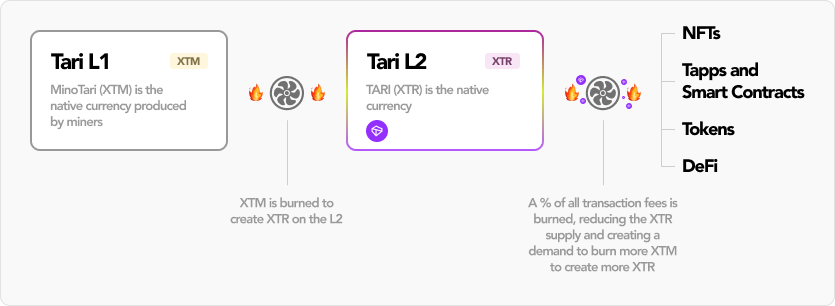
To ensure the long-term stability of the entire ecosystem, Tari has designed a dynamic adjustment mechanism driven by the validator node consensus algorithm:
- Partial burn mechanism: Layer 2 transaction fees (XTR) are not fully burned, with the burn ratio dynamically adjusted by algorithm.
- Core objectives: Sustain the pegged exchange rate between XTM and XTR; ensure dynamic balance in the supply of the two tokens; stabilize the total value of 21 billion tokens.
Token Economics Model
The operational foundation of the token economic model’s network is underpinned by an incentive mechanism, with the majority of tokens mined by miners.
- Total supply: 21 billion
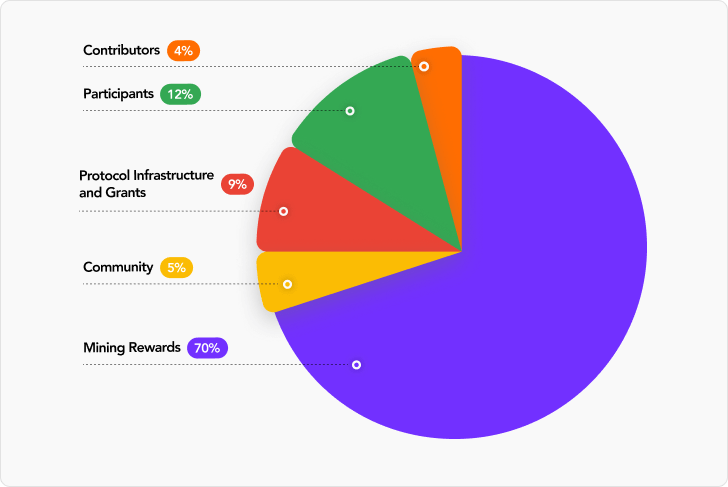
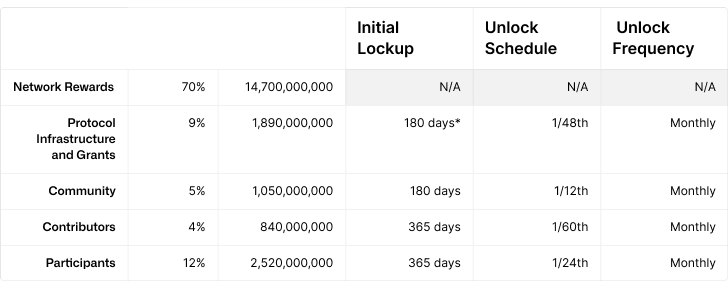
- Distribution plan: 30% pre-mined (covering private placement, team, ecosystem funds, etc.), 70% gradually released through mining.
- Release cycle: The pre-mined tokens will begin unlocking in batches starting from November 2025 (specific unclock schedules are subject to the latest official announcements ).
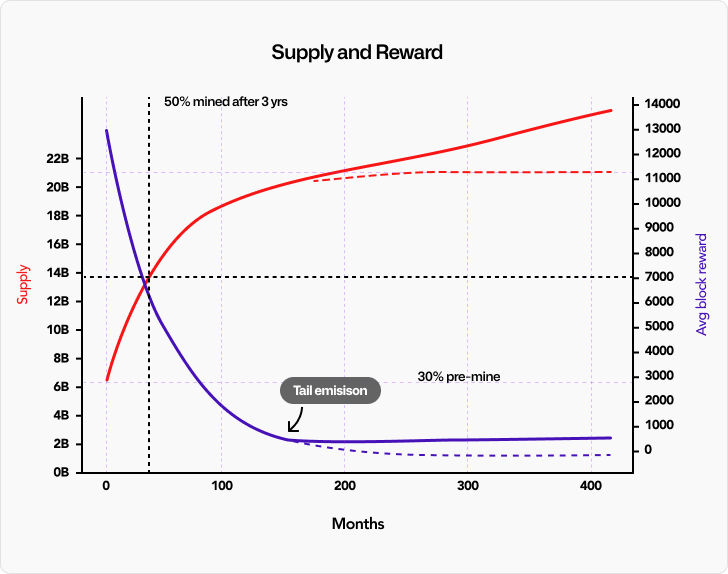
- Inflation model: The majority of tokens are planned to be released through mining over 12 years, after which the network will transition to moderate inflation of about 1% annually to continuously incentivize network security.
Mining Mechanism
- Total mining allocation: 70% of the 21 billion total supply (14.7 billion) will be produced through mining.
-
Core parameters:
- Block time: ≈2 minutes
- Initial block reward: theoretical value ≈13,000 tokens (actual initial value: 13,952 tokens)
- Reward distribution: Innovatively adopts four algorithms (SHA-3, RandomX-Monero, RandomX-Tari, Cuckaroo29), with block rewards evenly split (each algorithm accounts for 1/4). This design significantly improves network security, fairness, and decentralization.
- Halving mechanism: Block rewards follow a gradual per-block reduction model, halving approximately every 3 years, with the entire mining cycle lasting about 12 years.
Details of the four algorithms:
1.Tari RandomX Merge Mining
- Algorithm: RandomX
- Hardware: CPU
- Algorithm Explanation: RandomX is a mining algorithm optimized specifically for the CPUs of general-purpose computers. It has been adopted by Monero (XMR). Its design philosophy is to resist ASICs (application-specific integrated circuits) and FPGAs (field-programmable gate arrays), enabling ordinary people to effectively participate in mining using household computer CPUs. It achieves this by randomly executing multiple types of computations to simulate general-purpose computing, making ASIC chips designed solely for hash computation unprofitable.
- Target Group: Monero miners using CPUs
- PS: Merge Mining: Allows miners to mine one primary cryptocurrency (in this case, Monero) while, with almost no additional computing power, simultaneously mining another cryptocurrency (in this case, Tari). When miners mine Monero, their computing power is also used to validate transactions and blocks on the Tari network.
2.Tari RandomX Mining
- Algorithm: RandomX
- Hardware: CPU
- Algorithm Explanation: Uses the same algorithm as merge mining, RandomX.
- Target Group: Users with CPUs (desktops, laptops), even if they are not mining Monero.
3.SHA-3x Algorithm
- Algorithm: SHA-3x
- Hardware: ASIC and FPGA
- Algorithm Explanation: SHA-3x is a specific implementation or variant of the standard SHA-3 algorithm. SHA-3 is a set of cryptographic hash function standards certified by the U.S. National Institute of Standards and Technology (NIST). It is well known for its high security and efficiency.
- Target Group: ASIC/FPGA miners with SHA-3 algorithm capability
4.Cuckaroo29 (C29) Algorithm
- Algorithm: Cuckaroo29 (C29)
- Hardware: GPU
- Explanation: Cuckaroo29 is a specific parameter version based on the “Cuckoo Cycle” algorithm. This algorithm is completely different from other hash computation algorithms. It is primarily a graph theory problem, involving finding specific cycle structures within a very large graph.
- Target Group: Miners with graphics cards (GPUs)
Outlook
Tari, built by the Monero core team, stands as one of the few global blockchain protocols combining top-tier privacy features with high-performance Layer 2 scalability.
Its “privacy-first L1 + scalable L2” architecture offers a much-needed one-stop platform for the development and operation of privacy applications in Web3. Tari not only inherits Monero’s security and privacy DNA but also, through its innovative economic model and dual-layer design, lays a solid technical foundation for unlocking the future of digital assets and Web3 privacy applications, boasting enormous future growth potential.